Home gym equipment for wooden floors
Updated 2026-10-22 · By Charland & Co. · Based on published specs and public sources; we have not tested the products discussed.
Quick answer
Wood floors flex and dent under heavy gear. Divide each item's weight (plus you, if you stand or lie on it) by that item's own footprint in square feet, and put a mat or platform under anything heavy. The residential code's minimum is 40 lb per sq ft for most rooms and 30 for bedrooms (IRC Table R301.5).
How wood floors handle load
Wooden floors are not as strong as concrete or steel, but with the right planning, they can support a wide range of home gym equipment. The key is to compare your floor load (the weight per square foot you put on the floor) with the floor's rating from your landlord or a structural engineer. Upper floors and older joists deserve a closer look.
To work out your load, you need two numbers:
1. Each item's weight (plus you, if you stand or lie on it).
2. That item's own footprint in square feet.
The formula is:
Divide each item's weight (plus you, if you stand or lie on it) by that item's own footprint in square feet.
For example, a 200-lb person using a 100-lb barbell on a 10 sq ft area would have a floor load of:
200 + 100 = 300 lbs
300 / 10 = 30 lbs/sq ft
Compare that with the rating your landlord or a structural engineer gives you. The residential code's minimum is 40 lb per sq ft for most rooms and 30 for bedrooms (IRC Table R301.5).
How to protect wooden floors from damage
Even if your floor can handle the weight, heavy equipment can still cause indentations, scratches, or warping over time. Here are some ways to protect your wooden floors:
1. Use Floor Mats
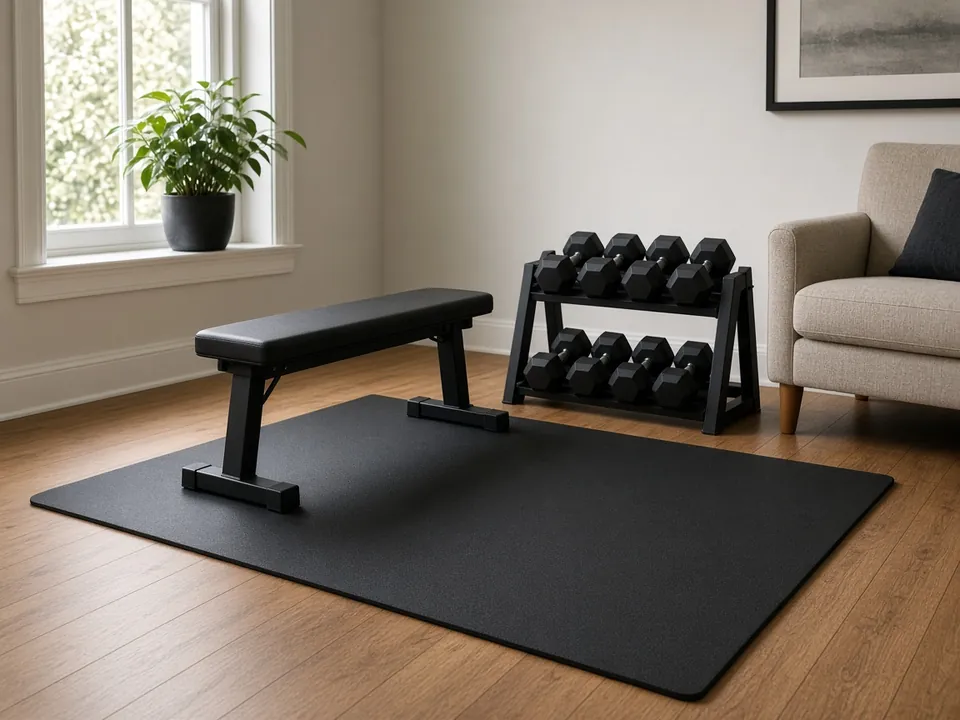
Mats spread the weight and keep equipment off the wood.
- Rubber mats are a common choice under heavy equipment because they resist denting and spread point loads better than foam.
- Foam mats are softer; they suit lighter equipment or cardio machines.
2. Avoid Direct Contact
On wood, put a mat or platform under anything heavy.
3. Distribute Weight Evenly
Avoid stacking heavy weights in one spot. Spread the weight across the floor using multiple mats or platforms.
4. Check for Floor Reinforcement
If you're unsure about your floor's strength, consult a structural engineer or your landlord. Some wooden floors may need reinforcement before heavy equipment is added.
Example: a 10x10 room on a wood floor
Let's say you have a 10x10 room (100 sq ft) with a wooden floor. You want to install a dumbbell rack and a barbell.
Step 1: Measure the Equipment
- Dumbbell rack: 4 ft wide x 2 ft deep = 8 sq ft
- Barbell: 4 ft long x 1 ft wide = 4 sq ft
Step 2: List Each Weight
- Dumbbell rack (rack plus dumbbells): 100 lbs
- Barbell: 150 lbs
- User: 200 lbs
Step 3: Calculate Floor Load
- Per item: dumbbell rack 100 lb ÷ 8 sq ft = 12.5 lb/sq ft; barbell 150 lb + you 200 lb = 350 lb over a 4 × 1 ft (4 sq ft) lifting area (example) = 87.5 lb/sq ft. Compare each figure with what your landlord or a structural engineer confirms. The IRC 40/30 psf figures are design minimums for loads spread evenly across a floor, not a safe rating for a loaded rack.
Step 4: Adjust Equipment or Layout
- Option 1: Use a lighter dumbbell rack (50 lbs, rack plus dumbbells) and a lighter barbell (100 lbs).
- rack 50 ÷ 8 = 6.25 lb/sq ft; barbell 100 + you 200 = 300 ÷ 4 = 75 lb/sq ft. Compare these with what your landlord or a structural engineer confirms.
- Option 2: a platform spreads point loads but does not raise the floor's capacity.
Wood-floor mistakes
- Ignoring floor load capacity and assuming the floor can handle anything.
- Using heavy equipment without mats or platforms.
- Overloading the floor with too much weight in one spot.
- Not checking with a structural engineer or landlord before installation.
- Using foam mats for heavy equipment instead of rubber mats.
Gear that suits a wood floor
When selecting equipment, consider the following:
1. Lightweight Equipment
Opt for equipment that weighs less, such as:
- Adjustable dumbbells (one set in place of many fixed pairs; check the listed weight)
- Resistance bands (no weight, no floor load)
2. Equipment with Small Footprints
Smaller equipment takes up less space, but a smaller footprint concentrates the load; work out each item's weight ÷ its own footprint. For example:
- Mini barbell stands (2 ft x 2 ft)
- Compact dumbbell racks (3 ft x 2 ft)
3. Use Mats and Platforms
Always use rubber mats or platforms to spread the weight and protect the floor.
Checking a wood floor's rating
If you're unsure about your floor's load capacity, follow these steps:
- Check with your landlord or property manager.
- Consult a structural engineer for a professional assessment.
- Look up local building codes for floor load requirements.
- Use a floor load calculator to estimate your load per square foot; it cannot tell you the floor's capacity.
For more help, see our floor load calculator.
Planning numbers: floor load
| Room | Code minimum (IRC R301.5) |
|---|---|
| Most rooms | 40 lb/sq ft |
| Bedrooms | 30 lb/sq ft |
Worked example: 600 lb on a 48 × 48 in (16 sq ft) footprint = 37.5 psf.
Questions about wooden floors
Q: Can I use a barbell on a wooden floor?
A: Yes, but only if you use a rubber mat and spread the weight across a large area. Avoid placing the barbell directly on the floor.
Q: What floor load can a wooden floor take?
A: There is no standard rating. For a rough comparison only, the IRC (Table R301.5) uses 40 lb/sq ft for most rooms and 30 for bedrooms.
Q: What should I do if my floor is too weak for my equipment?
A: Use mats or platforms to protect the surface, or choose lighter equipment. A mat won't raise floor capacity; ask your landlord or a structural engineer before any reinforcement, or move the gym somewhere stronger, such as a ground-level slab.
Q: Are foam mats good for wooden floors?
A: Foam mats suit heavy equipment only if the maker's load rating covers it. Rubber mats are a common choice under heavy equipment because they resist denting and spread point loads better than foam.
Q: Can I use a cable machine on a wooden floor?
A: Yes, but make sure the cable machine is lightweight and use a rubber mat to protect the floor.
Related guides
- How to Measure Your Space for a Home Gym
- Home Gym Equipment That Fits Small Spaces
- How to Calculate Floor Load for Home Gym Equipment
- How to Choose Home Gym Equipment for Concrete Floors
- Rubber Floor Mat vs Foam Floor Mat for Home Gyms
- How to Calculate Home Gym Equipment Footprint
- How to Choose Home Gym Equipment for a 250-Pound User
This guide is intended to help apartment, small-home, and garage owners choose home gym equipment that fits their space and protects their wooden floors. Always verify with your landlord or a structural engineer before installing heavy equipment. For more help, see our floor load calculator or how to measure your space.
Sources and method
- International Residential Code, Table R301.5 (minimum uniformly distributed live loads), as adopted in WAC 51-51-0301: 40 psf for areas other than sleeping areas and 30 psf for sleeping areas (local amendments vary).
- ICC Digital Codes: IRC 2018 Section R301.5: official text of the residential live-load table
- CPSC: Anchor It! furniture and TV tip-over prevention: why tall, heavy items should be anchored to the wall
- Factors and planning values on this page are TinyGymGuide example values (see Sources & method), not measured or maker figures.