Home gym equipment for concrete floors
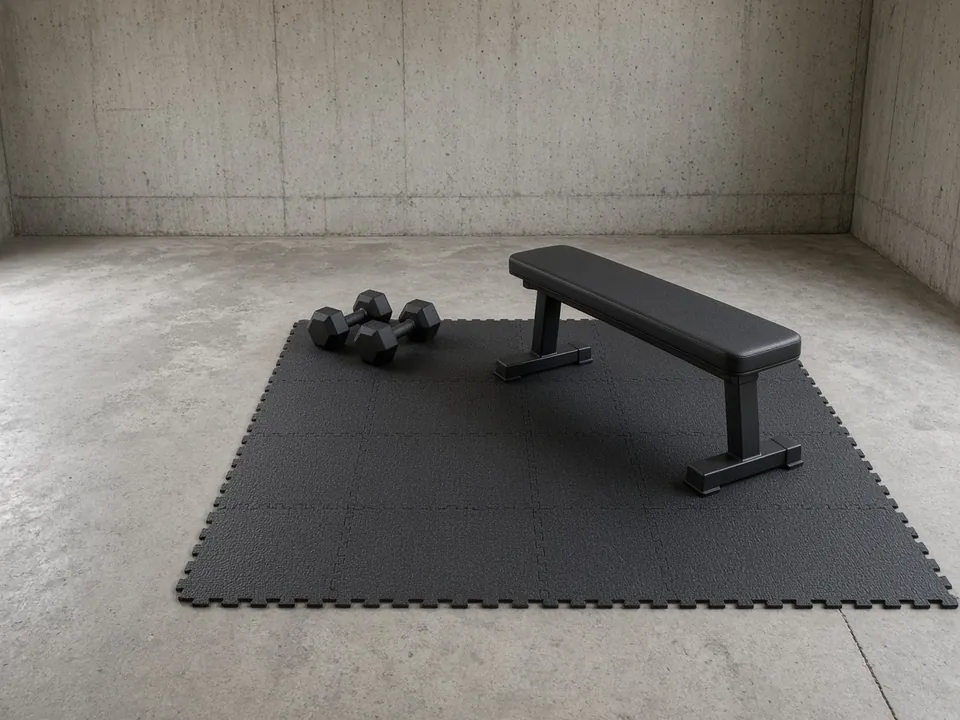
Updated 2026-10-22 · By Charland & Co. · Based on published specs and public sources; we have not tested the products discussed.
Quick answer
Slab strength varies, so spread heavy gear on a mat or platform. For load per square foot, divide each item's weight (plus you, if you stand or lie on it) by that item's own footprint in square feet. The residential code's minimum is 40 lb per sq ft for most rooms and 30 for bedrooms (IRC Table R301.5).
What a slab can take
Concrete is strong, but its ability to support weight depends on factors like slab thickness, rebar, and reinforcement. There is no single safe figure for a home slab; ask your landlord or a structural engineer if you plan heavy gear.
To work out floor load on a concrete floor, use this formula:
Divide each item's weight (plus you, if you stand or lie on it) by that item's own footprint in square feet.
For example, a 200-lb dumbbell rack with a 2 sq ft footprint:
200 lb / 2 sq ft = 100 lb/sq ft
That's above the 40 psf IRC uniform live-load figure, but that figure is a design load for framed floors, not a capacity rating for a slab on grade, so it isn't a pass/fail test. A 1,000-lb weight stack with a 3 sq ft footprint:
1,000 lb / 3 sq ft ≈ 333 lb/sq ft
We can't call that safe or unsafe from this number alone; spread the load with a platform and ask a structural engineer if the slab is old, thin or cracked.
Gear and mats for a slab
When selecting equipment, consider:
- Weight distribution: Wider bases or multiple contact points spread the load more evenly.
- Material: Steel and iron are heavy but durable. Rubber or foam mats help protect the floor and reduce noise.
- Footprint: Larger equipment needs more space. Use a footprint calculator to plan your layout.
For example, a rack with 9 pairs of 10–50 lb dumbbells (5 lb steps) holds 540 lb of dumbbells, plus the rack's own weight. If the rack is 4 ft wide and 2 ft deep:
4 ft x 2 ft = 8 sq ft
Then, the floor load is:
540 lb / 8 sq ft = 67.5 lb/sq ft (dumbbells only; add the rack's own weight)
Spread it with a mat or platform; this number isn't a slab rating.
Calculating floor load for a concrete floor
Say you want to install a cable machine that weighs 250 lb with a 3 ft x 2 ft footprint.
Step 1: Calculate the footprint
3 ft x 2 ft = 6 sq ft
Step 2: Calculate the floor load
250 lb / 6 sq ft ≈ 41.7 lb/sq ft
This is a rough figure only; point loads under the feet, or on an uneven area, can be much higher. Use a rubber vs foam floor mat guide to choose the right protection.
Slab setup slips
- Not using mats: Mats protect the slab surface from dropped weights and scuffs. Use a rubber vs foam floor mat guide to choose the right protection.
- Ignoring weight distribution: Narrow or heavy equipment can cause stress on the floor. Always check the footprint and use a floor load calculator.
- Assuming all concrete is the same: Older or improperly reinforced concrete may not support the same weight. Confirm with a structural engineer if in doubt.
Protecting concrete floors with mats and padding
Concrete is hard and can be noisy. Use rubber floor mats or foam mats to reduce noise and protect the surface.
- Rubber mats are durable and good for heavy equipment.
- Foam mats are softer but may wear out faster.
Use a thick rubber mat under all heavy equipment. This helps distribute the weight and protect the floor. Check the maker's thickness and density specs; there is no single required thickness.
Finding out what your slab can take
If you're unsure about your floor's capacity:
- Check with the landlord or building owner if you're renting. They may have information about the floor's construction.
- Consult a structural engineer for a professional assessment.
- Use a floor load calculator to estimate the load based on the equipment's weight and footprint.
For more details, see our floor load capacity guide.
Planning numbers: floor load
| Room | Code minimum (IRC R301.5) |
|---|---|
| Most rooms | 40 lb/sq ft |
| Bedrooms | 30 lb/sq ft |
Worked example: 600 lb on a 48 × 48 in (16 sq ft) footprint = 37.5 psf. The IRC 40/30 psf figures are design minimums for loads spread evenly across a floor, not a safe rating for a loaded rack. Ask your landlord or a structural engineer before loading the floor.
Questions about concrete floors
Q: Can I install a weight rack on a concrete floor without any mats?
A: You can, but a mat or platform under anything heavy protects the slab and the equipment. Use the rubber vs foam floor mat guide to choose one.
Q: What is the minimum floor load capacity for a concrete floor?
A: There is no single figure; it depends on the slab's construction and age. The residential code's minimum is 40 lb per sq ft for most rooms and 30 for bedrooms (IRC Table R301.5).
Q: How do I calculate the floor load for my equipment?
A: Divide each item's weight (plus you, if you stand or lie on it) by that item's own footprint in square feet. You can also use a floor load calculator for help.
Q: Is it safe to use a pull-up bar on a concrete floor?
A: Yes, but make sure the bar is mounted securely and the wall or ceiling can support the weight. For overhead moves, check the ceiling height requirements.
Q: What should I do if my concrete floor is old or not reinforced?
A: Consult a structural engineer to assess the floor's load capacity. Avoid heavy equipment unless the floor is confirmed to be safe.
Related guides
- How to Measure Your Space for a Home Gym
- Home Gym Equipment That Fits Small Spaces
- How to Choose Home Gym Equipment for a Garage
- How to Calculate Floor Load for Home Gym Equipment
- How to Calculate Home Gym Equipment Footprint
- How to Choose Home Gym Equipment for a Studio Apartment
- How to Choose Home Gym Equipment for a 7-Foot Ceiling
This guide is designed to help you make informed decisions about your home gym setup on a concrete floor. Always double-check your calculations and consult professionals when in doubt. For more help, visit our floor load calculator or footprint calculator tools.
Sources and method
- International Residential Code, Table R301.5 (minimum uniformly distributed live loads), as adopted in WAC 51-51-0301: 40 psf for areas other than sleeping areas and 30 psf for sleeping areas (local amendments vary).
- ICC Digital Codes: IRC 2018 Section R301.5: official text of the residential live-load table
- CPSC: Anchor It! furniture and TV tip-over prevention: why tall, heavy items should be anchored to the wall
- Factors and planning values on this page are TinyGymGuide example values (see Sources & method), not measured or maker figures.