Home gym equipment that fits small spaces
Updated 2026-10-22 · By Charland & Co. · Based on published specs and public sources; we have not tested the products discussed.
Prices as of 2026-10-23: none quoted. Any price we add will carry its own "price as of" date.
Quick answer
A compact adjustable dumbbell rack has a bare footprint of about 4.5 sq ft (example planning number). Add 18 inches to each dimension and the box grows, so check the maker's spec page. In a small space, favor gear that folds, stacks or mounts on a wall, and keep one open patch of floor for moving.
What counts as small-space gear
In a small room, every piece has to earn its floor space. Focus on gear that does several jobs or stores away.
For example, a single adjustable dumbbell rack can replace multiple sets of dumbbells, saving both space and money. A foldable treadmill or resistance band system can also be tucked away when not in use.
Check the footprint of each piece of equipment. Footprint is calculated by multiplying the length and width in feet. If dimensions are in inches, divide by 12 to convert to feet.
For example:
- A dumbbell rack that is 36 inches wide and 24 inches deep:
- Width in feet: 36 ÷ 12 = 3 ft
- Depth in feet: 24 ÷ 12 = 2 ft
- Footprint: 3 ft × 2 ft = 6 sq ft
When calculating clearance space, add 18 inches (1.5 ft) to both the length and width. This allows for safe movement and access.
For the same dumbbell rack:
- Clearance width: 3 ft + 1.5 ft = 4.5 ft
- Clearance depth: 2 ft + 1.5 ft = 3.5 ft
- Total clearance footprint: 4.5 ft × 3.5 ft = 15.75 sq ft
This means you need about 15.75 sq ft of space to use the dumbbell rack comfortably.
Kitting out a 10x10 room
You have a 10x10 ft room (100 sq ft) and want to fit a basic home gym. Plan the layout carefully.
Step 1: Determine the Equipment You Want
- Adjustable dumbbell rack (6 sq ft footprint, 15.75 sq ft with clearance)
- Foldable treadmill (4.5 sq ft footprint folded, 13.5 sq ft with clearance)
- Resistance bands (negligible footprint)
- Yoga mat (negligible footprint)
Step 2: Calculate Total Clearance Footprint
- Dumbbell rack: 15.75 sq ft
- Treadmill: 13.5 sq ft
- Total: 15.75 + 13.5 = 29.25 sq ft
Step 3: Check Room Size
- Room size: 100 sq ft
- Available space after equipment: 100 − 29.25 = 70.75 sq ft
- This is more than enough for movement and additional equipment.
Step 4: Consider Ceiling Height
- Dumbbell rack height: 6 ft
- Treadmill height: 5 ft
- Clearance needed above equipment: 12 in (1 ft)
- Total ceiling height needed: 6 ft + 1 ft = 7 ft
If your ceiling is at least that figure, the equipment fits; for overhead moves plan roughly your height plus about 2 feet (our planning estimate, not a measured figure). If not, choose lower-profile equipment or a different layout.
Small-room buying slips
-
Ignoring Clearance Space
Many forget to add the 18-inch clearance around equipment. This can lead to cramped conditions and safety issues. -
Overlooking Ceiling Height
Some equipment, like pull-up bars or overhead racks, require higher ceilings. Always check the manufacturer's specifications. -
Not Considering Floor Load Capacity
Heavy equipment like barbells or weight benches can stress the floor. Check your floor can support the weight. -
Choosing the Wrong Layout
A linear layout may not work in a small space. Consider a corner layout or a compact setup that makes the most of vertical space. -
Buying Too Much Equipment at Once
It's easy to get overwhelmed by the variety of equipment. Start with the essentials and expand as your space and needs grow.
Matching gear to your room
When selecting equipment for a small space, prioritize versatility and compactness. Options include:
1. Adjustable Dumbbell Rack
- Footprint: 6 sq ft
- Clearance: 15.75 sq ft (3 × 2 ft example, 18 in added to each dimension)
- Pros: Stores multiple dumbbell weights in one unit, saves space.
- Cons: Check the shelf rating before heavy lifting.
2. Foldable Treadmill
- Footprint: 4.5 sq ft
- Clearance: 13.5 sq ft (3 × 1.5 ft folded example, 18 in added to each dimension)
- Pros: Can be folded and stored when not in use.
- Cons: May take up more space when in use.
3. Resistance Bands and Accessories
- Footprint: Negligible
- Pros: Lightweight, portable, and versatile.
- Cons: Limited for heavy strength training.
4. Compact Weight Bench
- Footprint: 5 sq ft
- Clearance: about 15 sq ft (4 × 1.25 ft example, 18 in added to each dimension)
- Pros: Works for basic exercises like bench presses.
- Cons: Check its rated limit before heavy lifting.
5. Pull-Up Bar (if ceiling height is sufficient)
- Footprint: 1 sq ft
- Clearance: open floor in front of the bar
- Pros: Trains upper body strength.
- Cons: Full pull-ups need roughly your height plus about 2 feet (our planning estimate, not a measured figure).
Wall storage that frees floor
Here are a few tips to help you make the most of your small space:
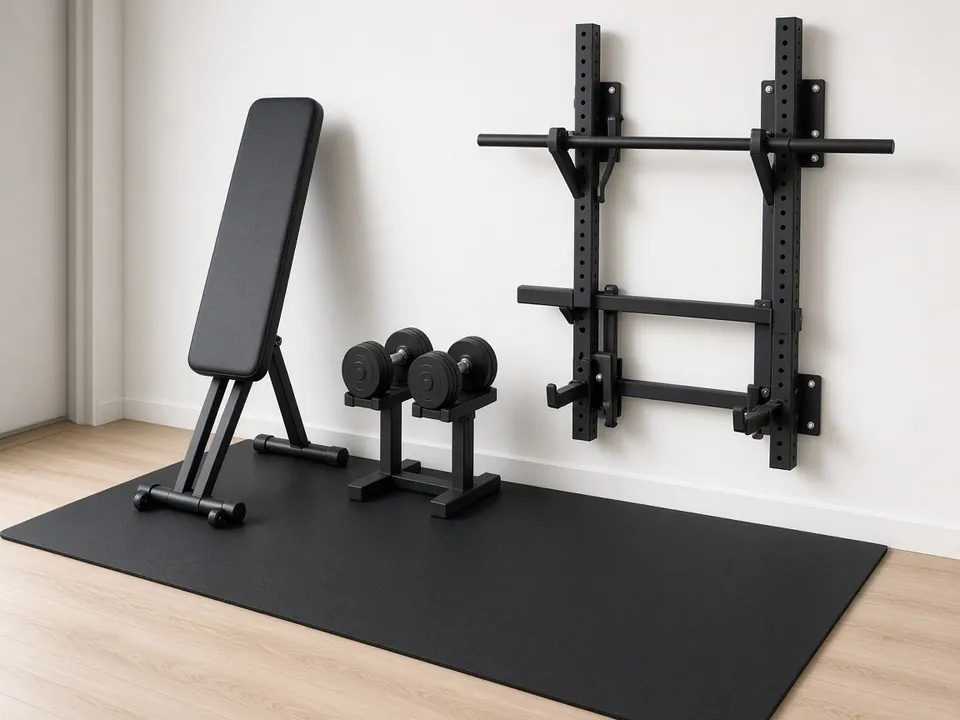
- Use the walls: Mount equipment like pull-up bars or overhead racks to save floor space.
- Choose foldable or collapsible equipment: These can be stored easily when not in use.
- Opt for multi-functional equipment: A weight bench can also be used for sit-ups or stretching.
- Keep the layout simple: A corner layout or a compact linear setup can work well in small spaces.
- Use mirrors or lighting: These can make a small space feel larger and more inviting.
Planning numbers: clearance footprint
| Example item | Footprint | With clearance |
|---|---|---|
| Rack, 48 × 48 in | 16 sq ft | 66 × 66 in (30.3 sq ft) |
| Flat bench, 48 × 24 in | 8 sq ft | 66 × 42 in (19.3 sq ft) |
| Dumbbell rack, 36 × 18 in | 4.5 sq ft | 54 × 36 in (13.5 sq ft) |
Questions about small-space gear
Q: What is the minimum ceiling height for a home gym?
A: There is no single minimum: your tallest piece's listed height plus 12 inches (our planning rule of thumb); overhead moves need roughly your height plus about 2 feet (our planning estimate).
Q: Can I use a treadmill in a small space?
A: Yes, but you'll need to choose a foldable treadmill and check its footprint plus our 18-inch clearance (about 13.5 sq ft for a 3 × 1.5 ft folded example). Also check the floor load capacity to make sure your floor can support the weight.
Q: What is the best equipment for a studio apartment?
A: Gear that suits a studio apartment includes adjustable dumbbell racks, resistance bands, and foldable treadmills. These are compact, versatile, and can be stored easily.
Q: How do I calculate floor load?
A: To calculate floor load, divide each item's weight (plus you, if you stand or lie on it) by its own footprint in square feet. For example, if you have a 100-lb weight bench on a 5 sq ft footprint, the floor load is 20 lb/sq ft. Compare this with the floor's load capacity, which you can confirm with your landlord or a structural engineer.
Q: What should I do if my ceiling is too low for full pull-ups?
A: Skip full pull-ups and standing presses; a bar can still serve for dead hangs if you can hang at full arm's length with your feet clear of the floor (bend your knees if needed).
Related guides
If you're ready to calculate the footprint of your equipment, check out our footprint calculator. You can also learn more about ceiling height requirements and floor load capacity.
For more layout ideas, see our 5x5 home gym layout and corner vs linear layout guides.
Sources and method
- International Residential Code, Table R301.5 (minimum uniformly distributed live loads), as adopted in WAC 51-51-0301: 40 psf for areas other than sleeping areas and 30 psf for sleeping areas (local amendments vary).
- ICC Digital Codes: IRC 2018 Section R301.5: official text of the residential live-load table
- CPSC: Anchor It! furniture and TV tip-over prevention: why tall, heavy items should be anchored to the wall
- Factors and planning values on this page are TinyGymGuide example values (see Sources & method), not measured or maker figures.