Rubber floor mat vs foam floor mat for home gyms
Updated 2026-10-22 · By Charland & Co. · Based on published specs and public sources; we have not tested the products discussed.
Quick answer
Rubber mats are denser and less likely to compress under weight, so they suit heavy equipment and dropped weights. Foam is softer, which suits bodyweight work and stretching; prices vary by product. Load rating: see the maker's spec page, where it is often given as a density or compression rating, and check the thickness too.
How rubber and foam differ
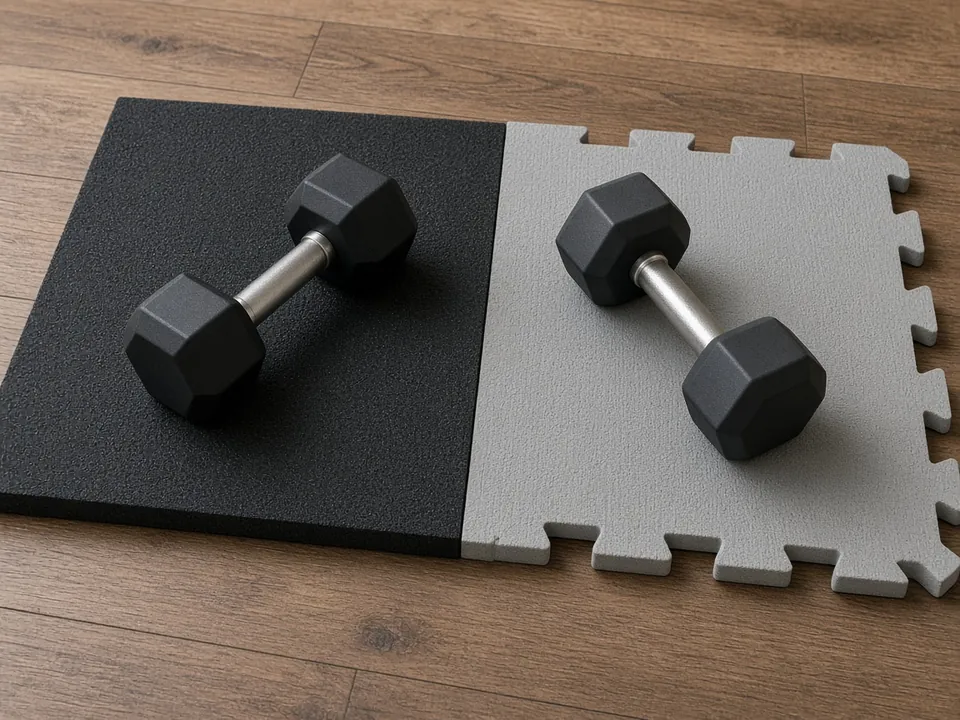
Rubber handles dropped weight; foam is softer underfoot. The right choice depends on the equipment you plan to use.
Rubber mats are made from natural or synthetic rubber, while foam mats are made from materials like polyethylene or polyurethane. Both are available in various thicknesses, but their performance can vary significantly based on the material and construction.
Choosing a mat: the numbers
Let's say you have a home gym in a garage with a concrete floor and plan to use a barbell rack and a squat stand. You want to choose between a 1/2-inch thick rubber mat and a 1-inch thick foam mat (example thicknesses).
Step 1: Calculate Floor Load
- Barbell rack: 200 lb ÷ its own 4 ft × 4 ft (16 sq ft, example) footprint = 12.5 lb/sq ft. Work out the squat stand the same way on its own footprint.
Step 2: Convert Floor Load to psi
- 1 sq ft = 144 sq in
- 12.5 lb/sq ft ÷ 144 ≈ 0.087 lb/sq in
- 0.087 psi is the average over the footprint; pressure under the feet is much higher.
Step 3: Compare Mat Support
- Rubber mat (1/2 inch): Load rating: see the maker's spec page (often given as density or compression rating).
- Foam mat (1 inch): Load rating: see the maker's spec page (often given as density or compression rating).
Step 4: Consider Impact and Comfort
- Rubber mat: Durable, non-slip, and provides good shock absorption for heavy lifts.
- Foam mat: Softer and more comfortable for low-impact workouts like yoga or stretching.
Step 5: Choose Based on Needs
- If you plan to use heavy equipment, go with a rubber mat.
- If you're doing mostly low-impact workouts, a foam mat may be sufficient.
Mat mistakes
- Choosing a mat based only on thickness: Thickness counts, but the material and support rating matter more.
- Ignoring the weight of the equipment: Even a thin rubber mat can support heavy weights if the maker's load rating suits it.
- Using foam mats for heavy equipment: Check the foam's maker load rating before putting barbells or squat stands on it.
- Assuming all mats are the same: Rubber and foam mats have different properties and are suited for different types of workouts.
Side by side: rubber vs foam
| Feature | Rubber Floor Mat | Foam Floor Mat |
|---|---|---|
| Under dropped weights | Resists denting | Can dent |
| Load Capacity | See the maker's spec page | See the maker's spec page |
| Comfort | Moderate | High |
| Underfoot | Firmer | Softer |
| Cost | Varies by model | |
| Suits | Heavy equipment, high-impact workouts | Low-impact workouts, yoga, stretching |
When rubber or foam wins
- You have heavy equipment: Rubber floor mat
- You do mostly yoga or stretching: Foam floor mat
- You have a concrete floor: Rubber floor mat (a common choice on concrete)
- You have a wooden floor: Foam floor mat for light gear (softer underfoot); use rubber under heavy equipment
- You want maximum comfort: Foam floor mat
- You drop weights: Rubber floor mat
Example: a home gym in a garage
Imagine you live in a suburban area and have a 2-car garage that you want to convert into a home gym. The garage has a concrete floor and you plan to use a barbell rack, a squat stand, and a pull-up bar.
Step 1: Measure the Space
- Garage dimensions: 20 ft x 15 ft = 300 sq ft
- Barbell rack footprint: 4 ft × 4 ft = 16 sq ft; subtract the squat stand and pull-up bar footprints too.
Step 2: Choose the Right Floor Mat
- Barbell rack: 200 lb ÷ its own 4 ft × 4 ft (16 sq ft, example) footprint = 12.5 lb/sq ft. Work out the squat stand the same way on its own footprint.
- Convert to psi: 12.5 lb/sq ft ÷ 144 ≈ 0.087 lb/sq in
Step 3: Final Decision
- Choose a rubber mat.
- Add a foam mat in the area where you'll do yoga or stretching for added comfort.
Planning numbers: floor load
| Room | Code minimum (IRC R301.5) |
|---|---|
| Most rooms | 40 lb/sq ft |
| Bedrooms | 30 lb/sq ft |
Worked example: 600 lb on a 48 × 48 in (16 sq ft) footprint = 37.5 psf. The IRC 40/30 psf figures are design minimums for loads spread evenly across a floor, not a safe rating for a loaded rack. Ask your landlord or a structural engineer before loading the floor.
Questions about rubber and foam mats
Q: Can I use a foam mat with a barbell rack?
A: Yes, but only if the foam mat has a suitable load rating on the maker's spec page. Rubber mats are a common choice under heavy equipment because they resist denting and spread point loads better than foam.
Q: Are rubber mats more expensive than foam mats?
A: Prices vary by product; compare per-square-foot prices for the thickness you need.
Q: Do rubber mats make noise?
A: Both can make some noise when you drop weights or move equipment; check the maker's spec page.
Q: Can I install a rubber mat over a foam mat?
A: Yes, but it's not common. Rubber mats are usually placed directly on the floor, while foam mats can be used as a base or added on top for extra comfort.
Q: How thick should a rubber mat be for a home gym?
A: Check the maker's thickness and density specs; there is no single required thickness. Thicker mats provide more cushioning but take up more space.
Related guides
- How to Measure Your Space for a Home Gym
- Home Gym Equipment That Fits Small Spaces
- How to Choose Home Gym Equipment for a Garage
- How to Calculate Floor Load for Home Gym Equipment
- How to Choose Home Gym Equipment for Concrete Floors
- How to Calculate Home Gym Equipment Footprint
This page is part of TinyGymGuide, a US-focused resource for apartment, small-home and garage owners.
Sources and method
- International Residential Code, Table R301.5 (minimum uniformly distributed live loads), as adopted in WAC 51-51-0301: 40 psf for areas other than sleeping areas and 30 psf for sleeping areas (local amendments vary).
- ICC Digital Codes: IRC 2018 Section R301.5: official text of the residential live-load table
- CPSC: Anchor It! furniture and TV tip-over prevention: why tall, heavy items should be anchored to the wall
- Factors and planning values on this page are TinyGymGuide example values (see Sources & method), not measured or maker figures.