Updated 2026-10-22 · By Charland & Co. · Based on published specs and public sources; we have not tested the products discussed.
Prices as of 2026-10-23: none quoted. Any price we add will carry its own "price as of" date.
Buy equipment for a 5x5 space
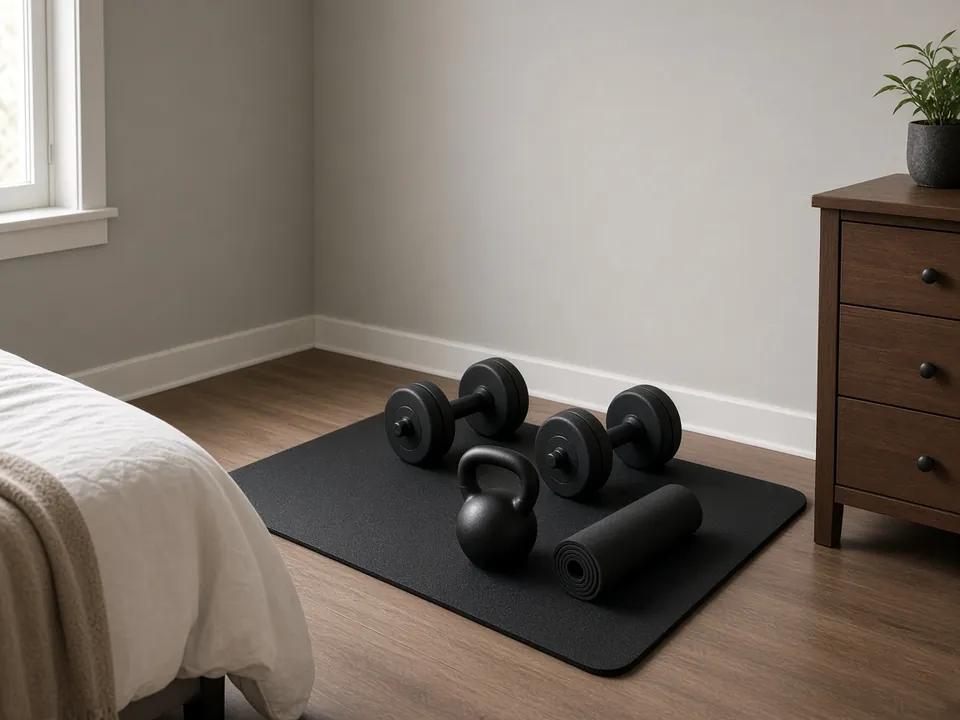
A 5x5 space is 25 square feet. That's a small but usable area for a home gym if you choose the right equipment. The key is to focus on compact, multi-functional gear that fits within the space and meets your fitness goals.
Quick answer
In a 5x5 space with 25 sq ft, buy compact gear whose footprint, with 18 inches added to each dimension, still fits. Check the maker's listed dimensions, make sure the ceiling is the equipment height plus 12 inches, and work out floor load as each item's weight ÷ its own footprint before you buy.
What a 25 sq ft space can take
A 5x5 space is 5 feet by 5 feet, or 25 square feet: room for one main piece plus storage if you plan before you buy.
- Measure the space: tape the exact width, depth and ceiling first; see how to measure your space.
- Match your goals: strength work points to adjustable dumbbells on a compact rack; bodyweight work to a pull-up bar or suspension trainer.
- Check headroom: for pull-ups and overhead moves, plan roughly your height plus about 2 feet (our planning estimate, not a measured figure); see ceiling height requirements.
Fitting a dumbbell rack: the numbers
Let's say you want to fit a dumbbell rack in a 5x5 space.
Step 1: Measure the Equipment
- Dumbbell rack width: 36 inches
- Dumbbell rack depth: 24 inches
- Dumbbell rack height: 72 inches
Step 2: Convert Inches to Feet
- Width: 36 inches ÷ 12 = 3 feet
- Depth: 24 inches ÷ 12 = 2 feet
- Height: 72 inches ÷ 12 = 6 feet
Step 3: Calculate Footprint
- Footprint: 3 feet x 2 feet = 6 square feet
Step 4: Add Clearance
- Clearance width: 3 feet + 1.5 feet = 4.5 feet
- Clearance depth: 2 feet + 1.5 feet = 3.5 feet
Step 5: Check Space Fit
- Total space needed: 4.5 feet x 3.5 feet = 15.75 square feet
This is well within the 25 square feet of a 5x5 space. You'll have 9.25 square feet of extra space for other equipment or movement.
Purchases that overfill 25 sq ft
- Buying oversized equipment that doesn't fit in the space.
- Ignoring ceiling height requirements for overhead moves.
- Overlooking floor load capacity, so a heavy rack can dent or overload the floor under it.
- Not checking for clearance around the equipment, so you knock into walls mid-lift.
- Assuming all equipment is the same, when in reality, some are more compact and multi-functional.
Before you order: checklist
When shopping for a 5x5 space, check these specs:
- Footprint: aim for under 10 sq ft bare; convert width and depth to feet and add 18 inches to each.
- Ceiling: for pull-ups and overhead moves, plan roughly your height plus about 2 feet.
- Floor load: divide each item's weight (plus you, if you stand or lie on it) by that item's own footprint in square feet, then compare it with the rating your landlord confirms.
- Rated weight: above your body weight plus anything you load.
- Build: steel or reinforced plastic, with non-slip or rubber feet so it stays put.
- Space savers: gear that folds, stacks or does two jobs, such as a rack with a pull-up bar, and a corner spot for it.
Planning numbers: clearance footprint
| Example item | Footprint | With clearance |
|---|---|---|
| Rack, 48 × 48 in | 16 sq ft | 66 × 66 in (30.3 sq ft) |
| Flat bench, 48 × 24 in | 8 sq ft | 66 × 42 in (19.3 sq ft) |
| Dumbbell rack, 36 × 18 in | 4.5 sq ft | 54 × 36 in (13.5 sq ft) |
Questions about buying for a 5x5 space
1. Can I fit a treadmill in a 5x5 space?
A typical treadmill deck is longer than 5 feet, so most won't fit a 5x5 space even before clearance; check the maker's listed length and rear clearance.
2. What is the best equipment for a 5x5 space?
For a 5x5 space, use adjustable dumbbells on a compact rack, resistance bands, a folding bench.
3. How do I calculate floor load?
To calculate floor load, divide each item's weight (plus you, if you stand or lie on it) by that item's own footprint in square feet. For example, if you have a 100-pound dumbbell rack on a 6 square foot footprint, the floor load is 16.67 pounds per square foot (100 ÷ 6 = 16.67 ✓). Compare it with what your landlord or a structural engineer confirms.
4. What if my ceiling is low?
If your ceiling is lower than roughly your height plus about 2 feet (our planning estimate, about 8 feet for a 6-foot person), avoid overhead moves. Instead, focus on bodyweight exercises, dumbbell training, or resistance bands. For more details, see How to Choose Home Gym Equipment for Low Ceiling Spaces.
5. Can I use a 5x5 space for functional training?
Yes, a 5x5 space can be used for functional training if you choose the right equipment. Look for kettlebells, medicine balls, and resistance bands. These items are compact and can be used for a variety of exercises.
Related guides
- How to Measure Your Space for a Home Gym
- Home Gym Equipment That Fits Small Spaces
- How to Choose Home Gym Equipment for a Studio Apartment
- How to Calculate Home Gym Equipment Footprint
- Smart Layouts for a 5x5 Home Gym
If you're ready to plan your layout, check out Smart Layouts for a 5x5 Home Gym for tips on making the most of your space.
Sources and method
- International Residential Code, Table R301.5 (minimum uniformly distributed live loads), as adopted in WAC 51-51-0301: 40 psf for areas other than sleeping areas and 30 psf for sleeping areas (local amendments vary).
- ICC Digital Codes: IRC 2018 Section R301.5: official text of the residential live-load table
- CPSC: Anchor It! furniture and TV tip-over prevention: why tall, heavy items should be anchored to the wall
- Factors and planning values on this page are TinyGymGuide example values (see Sources & method), not measured or maker figures.