Home gym equipment for low ceilings
Updated 2026-10-23 · By Charland & Co. · Based on published specs and public sources; we have not tested the products discussed.
Quick answer
For a 6-foot (72-inch) ceiling, choose equipment no taller than 60 inches, leaving 12 inches overhead (our rule of thumb). That rules out most full racks and pull-up bars, so favor adjustable dumbbells, a flat bench, bands and seated presses. Check each maker's listed height, and measure under the lowest beam or duct.
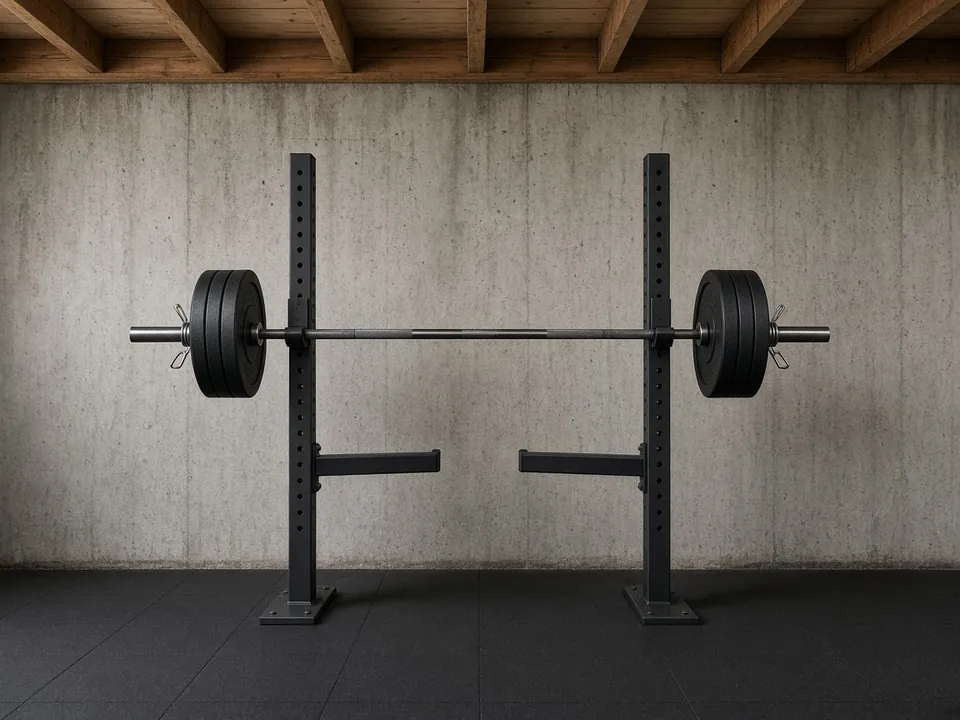
What a 72-inch ceiling allows
When choosing home gym equipment for low ceiling spaces, the first thing to consider is the ceiling height. Many full-size racks and cable machines stand 80 inches or taller (REP lists its PR-1000 rack at 83.6 in and the Arcadia functional trainer at 80.8 in; Force USA lists the G3 at 87 in), so a low ceiling rules out a lot of standard gear. However, if your ceiling is lower, you'll need to select equipment that fits within your available height and still allows for proper overhead clearance.
A general rule of thumb is to leave at least 12 inches of overhead clearance above the tallest piece of equipment. This gives you enough room to move safely and avoid hitting your head or the ceiling. For example, if your equipment is 60 inches tall, your ceiling should be at least 72 inches (6 feet) high.
If you're unsure about your ceiling height, you can use the ceiling height calculator to determine the minimum height required for your chosen equipment.
Example: a 6-foot ceiling in a studio apartment
Let's say you live in a studio apartment with a 6-foot ceiling (72 inches). You want to set up a small home gym that includes a dumbbell rack, a pull-up bar, and a cable machine.
Here's how you might approach this:
- Measure your ceiling height to confirm it is 72 inches.
- Check the height of each piece of equipment.
- e.g. a 48-inch rack (example height).
- A full-size cable machine is often 80 inches or taller (REP Arcadia 80.8 in, Force USA G3 87 in, per the maker spec pages). - Calculate the required overhead clearance for each piece.
- Dumbbell rack: 48 inches + 12 inches = 60 inches (5 feet).
- Cable machine: 80.8 inches + 12 inches = 92.8 inches, well over 72 inches, so a full-size cable tower does not fit here. - Compare these numbers to your ceiling height (72 inches).
- Pull-up bar: hangs only. Full pull-ups need roughly your height plus about 2 feet (our planning estimate, not a measured figure): about 96 in for a 6 ft person, so they don't fit a 72-inch ceiling. The dumbbell rack fits with 12 inches of overhead clearance; a full-size cable machine does not.
This example shows that even with a 6-foot ceiling, you can still set up a functional home gym with the right equipment.
Calculating ceiling requirements for a cable machine
Let's say you want to install a cable machine in a space with a 7-foot ceiling (84 inches).
- Determine the height of the cable machine.
- Check the maker's listed height. REP lists the Arcadia at 80.8 inches tall. - Add the required overhead clearance.
- 80.8 inches + 12 inches = 92.8 inches (about 7 ft 9 in). - Compare to your ceiling height.
- 84 inches (7 feet) is 8.8 inches short of the clearance we plan for. - Conclusion: This full-size cable machine does not fit a 7-foot ceiling. Look for a model whose listed height is 72 inches or less (84 − 12), or use bands.
This calculation helps you choose equipment that is both safe and functional for your space.
Low-ceiling errors
When choosing home gym equipment for low ceiling spaces, it's easy to end up hitting the ceiling on a press. Here are some common mistakes to avoid:
- Ignoring overhead clearance: Even if your equipment is short, you still need at least 12 inches of space above it.
- Choosing equipment that is too tall: A 6-foot (72-inch) machine needs 72 + 12 = 84 inches, so a 7-foot ceiling leaves no margin; check the maker's manual clearance.
- Not checking the manufacturer's specifications: Some equipment may have different height requirements than the general rule of thumb.
- Overlooking the user's height: If you are tall, you may need more overhead clearance than the standard 12 inches.
- Assuming all equipment is the same size: Cable machines, pull-up bars, and dumbbell racks can vary in height and width.
Avoiding these mistakes can help you create a safe and effective home gym that fits your space.
Gear under 60 inches
When selecting home gym equipment for low ceiling spaces, choose pieces that are compact and do not require excessive vertical space. Here are some options that work well in low-ceiling environments:
- Dumbbell racks: e.g. a 48-inch rack (example height). They can be placed in corners or along walls.
- Pull-up bars: Under a low ceiling, use a bar for hangs. Full pull-ups need roughly your height plus about 2 feet (our planning estimate, not a measured figure).
- Cable machines: Most full-size units are 80 inches or taller. Check the maker's listed height against your ceiling minus 12 inches.
- Resistance bands: These are low-profile and do not require much vertical space.
- Adjustable dumbbells: These are compact and can be stored in a small footprint.
For more ideas on equipment that works well in small spaces, check out the home gym equipment that fits small spaces page.
Using the height you have
Even with a low ceiling, you can make the most of your vertical space by using equipment that is designed for compact setups. Here are some tips to help you make the most of your space:
- Use wall-mounted equipment: Pull-up bars, dumbbell racks, and cable machines can be mounted on walls or ceilings to save floor space.
- Choose compact equipment: Look for equipment whose listed height is at least 12 inches below your ceiling and that has a small footprint.
- Use corner spaces: Place equipment in corners to save space and make the most of your layout.
- Opt for adjustable equipment: Adjustable dumbbell racks and cable machines can be customized to fit your needs.
- Use overhead space wisely: With a 7-foot ceiling, full pull-ups are too tight for most adults. Use a bar for hangs, or choose floor-based pulling moves.
By using these strategies, you can create a functional home gym that fits your space and meets your fitness goals.
Planning numbers: ceiling height
| Equipment | Listed height | Ceiling to plan for |
|---|---|---|
| REP PR-1050 short power rack | 72 in | 84 in (7 ft) |
| REP Arcadia functional trainer | 80.8 in | 92.8 in |
| REP Arcadia Max | 87.6 in | 99.6 in |
| Force USA G3 all-in-one | 87 in | 99 in |
Sources: REP rack guide for the PR-1050 (72 in) and PR-1000 (83.6 in); REP Arcadia and Arcadia Max product pages; Force USA G3 product page. Makers change specs; check the page before you buy.
Questions about low ceilings
Q: What is the minimum ceiling height for a home gym?
A: There is no single minimum. Work from your tallest piece: its listed height plus 12 inches (our planning rule of thumb). For overhead moves, plan roughly your height plus about 2 feet (our planning estimate, not a measured figure).
Q: Can I use a pull-up bar in a 6-foot ceiling?
A: Not for full pull-ups for most adults. You need roughly your height plus reach (a 6 ft person with ~2 ft of reach needs about 8 ft), so a 72-inch ceiling is too low. Use the bar for hangs or pick floor-based moves.
Q: What is the best equipment for a 6-foot ceiling?
A: Dumbbell racks, benches and compact machines no taller than 60 inches (72 − 12, our planning rule of thumb). Check the maker's spec page for height.
Q: How do I calculate the required ceiling height for my equipment?
A: To calculate the required ceiling height, add the height of the equipment to 12 inches for overhead clearance. For example, a 48-inch dumbbell rack requires a 60-inch (5-foot) ceiling.
Q: Can I use a cable machine in a 6-foot ceiling?
A: Not a full-size one: units like the REP Arcadia (80.8 in) are taller than the ceiling itself. Look for a model with a listed height of 60 inches or less (72 − 12, our planning rule of thumb), or use bands.
Related guides
If you're ready to start planning your home gym, here are some useful resources to help you get started:
- How to Measure Your Space for a Home Gym
- Home Gym Equipment That Fits Small Spaces
- How to Choose Home Gym Equipment for a Studio Apartment
- How to Calculate Ceiling Height for Home Gym Equipment
- How to Choose Home Gym Equipment for a 7-Foot Ceiling
TinyGymGuide is brought to you by Charland & Co. We help apartment, small-home, and garage owners fit home gym equipment into tight spaces using measurements and maker specs.
Sources and method
- International Residential Code, Table R301.5 (minimum uniformly distributed live loads), as adopted in WAC 51-51-0301: 40 psf for areas other than sleeping areas and 30 psf for sleeping areas (local amendments vary).
- ICC Digital Codes: IRC 2018 Section R301.5: official text of the residential live-load table
- CPSC: Anchor It! furniture and TV tip-over prevention: why tall, heavy items should be anchored to the wall
- Factors and planning values on this page are TinyGymGuide example values (see Sources & method), not measured or maker figures.