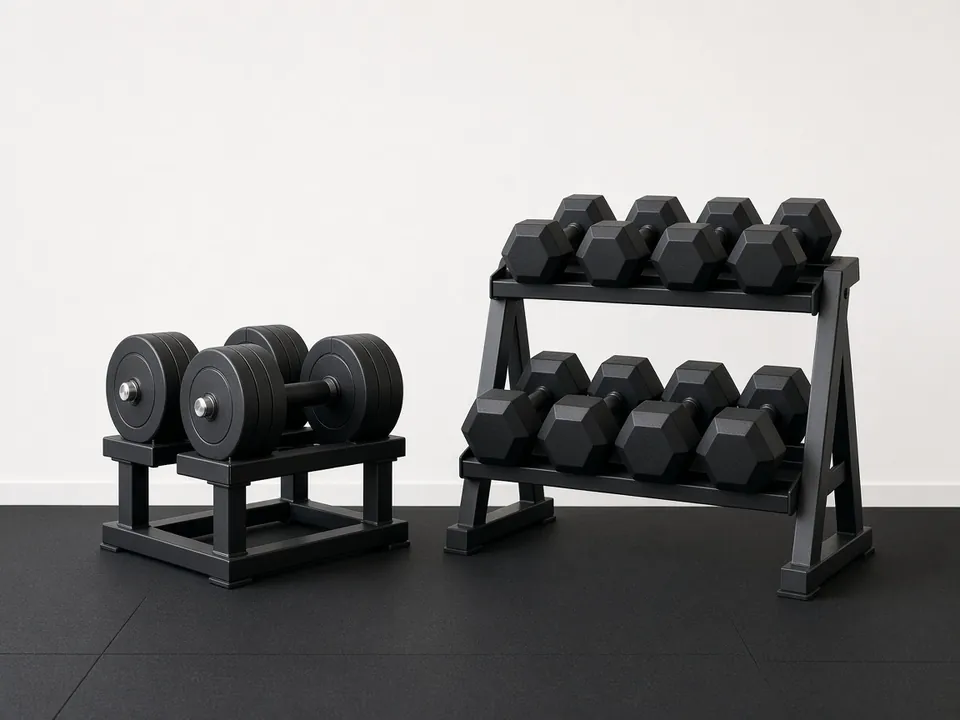
Adjustable dumbbell rack vs fixed dumbbell rack
Updated 2026-10-22 · By Charland & Co. · Based on published specs and public sources; we have not tested the products discussed.
Quick answer
Weight ratings vary by model, so compare space and flexibility too. An adjustable set holds a range of weights on one small footprint; a fixed rack can need more wall width, depending on the model, but is quicker between sets. Check the shelf capacity on the maker's spec page, since it varies by model.
How the two rack types differ
When choosing between an adjustable and a fixed dumbbell rack, consider the weight capacity, stability, and flexibility of the rack. Fixed racks keep the same shelf layout, which suits users who prefer a consistent setup and don't plan on changing their dumbbell configuration often.
Weight capacity and stability
Weight capacity is a key factor when selecting a dumbbell rack. Both adjustable and fixed racks can support similar weight capacities, depending on the number of shelves and the materials used. Check the shelf capacity on the maker's spec page; it varies by model.
Stability matters too. Check the base width and the maker's spec page, especially if you plan to store heavier dumbbells or the rack sits near the edge of a room.
Calculating weight capacity
Let's say you have a set of dumbbells that weigh a total of 300 lbs. You want to store them in a rack that can safely hold the weight without compromising stability.
- Determine the number of shelves: If you choose a rack with three shelves, each shelf would need to support 100 lbs (300 lbs ÷ 3 shelves = 100 lbs per shelf).
- Check the weight capacity of the rack: Check the shelf capacity on the maker's spec page; it varies by model. You need at least 100 lbs per shelf (300 ÷ 3 = 100).
- Check the stability: look for reinforced bracing and a wide base on the maker's spec page, especially if the dumbbells are heavier or if the rack is placed in a corner.
This example shows how choosing the right type of rack can make a significant difference in both safety and functionality.
Rack-buying slips
- Choosing a rack with insufficient weight capacity: Always check the weight capacity of the rack before purchasing. If the rack cannot support the weight of your dumbbells, it may tip or become unstable.
- Ignoring the need for stability: A rack that is not stable can be dangerous, especially if it is placed in a high-traffic area or near the edge of a room.
- Overlooking the flexibility of adjustable racks: If you plan to change your dumbbell configuration over time, an adjustable rack lets you reconfigure it.
- Not considering the space requirements: Both adjustable and fixed racks require a certain amount of space. Make sure to measure your area before purchasing a rack to make sure it fits comfortably.
Side by side: adjustable vs fixed
| Feature | Adjustable Dumbbell Rack | Fixed Dumbbell Rack |
|---|---|---|
| Weight Capacity | Check the maker's spec page (varies by model) | Check the maker's spec page (varies by model) |
| Stability | Depends on model; check the spec page | Depends on model; check the spec page |
| Flexibility | High, shelves can be adjusted | Low, shelves are fixed |
| Space Requirements | Check the maker's listed footprint | Check the maker's listed footprint |
| Cost | Depends on model; check the spec page | Depends on model; check the spec page |
| Suits | Users with varying dumbbell sizes or who may reconfigure their space | Users with a consistent setup |
Pick adjustable if… or fixed if…
- You have a variety of dumbbell sizes: Choose an adjustable rack for its flexibility.
- You want a consistent setup: A fixed rack suits you if you don't plan on changing your dumbbell configuration.
- You have a small space: An adjustable rack can be more versatile, but make sure it fits within your available space.
- You plan to store heavier weights: Choose a rack whose maker-rated shelf capacity covers the heaviest weights.
- You want a cost-effective solution: Cost depends on model; compare prices on the maker's page.
Example: a rack in a spare-room corner
Imagine you're a college student living in a small apartment with a 5x5 foot space. You want to set up a home gym but are limited by space and budget. You have a set of dumbbells that weigh a total of 300 lbs and need a rack that can safely hold them.
- Measure the space: Your 5x5 foot space gives you 25 sq ft of area. Add 18 inches to the rack's width and depth (TinyGymGuide planning rule of thumb, not a code or maker figure; use your maker's manual clearance if it differs). So the rack can be no wider than 60 − 18 = 42 in.
- Choose the right rack: For 300 lbs of dumbbells on three shelves, each shelf must hold at least 300 ÷ 3 = 100 lbs. Check the shelf capacity on the maker's spec page; it varies by model.
- Check stability: look for reinforced bracing and a wide base on the maker's spec page, especially in a small space.
- Calculate floor load: If the rack is 3.5 ft wide and 3 ft deep, the footprint is 3.5 ft x 3 ft = 10.5 sq ft. The dumbbells alone give 300 lb ÷ 10.5 sq ft = 28.57 lb/sq ft; add the rack's own weight from its spec page before comparing. Make sure your floor can support this load, or consult a structural engineer or landlord. The residential code's minimum is 40 lb per sq ft for most rooms and 30 for bedrooms (IRC Table R301.5).
This scenario shows how an adjustable rack can fit a small space, especially if you plan to store a variety of dumbbells or may need to reconfigure your setup over time.
Planning numbers: total load
| Part | Example |
|---|---|
| You | 350 lb |
| Loaded bar and plates | 225 lb |
| Total the bench or rack must carry | 575 lb |
Use the maker's listed capacity, not a typical figure.
Questions about dumbbell racks
Q: Can I use an adjustable dumbbell rack for fixed dumbbells?
A: Yes, an adjustable rack can be used for fixed dumbbells.
Q: How do I make sure the stability of an adjustable rack?
A: To make sure stability, choose an adjustable rack with reinforced bracing, a wide base, and a weight capacity that matches your dumbbell needs. Avoid placing the rack near the edge of a room or in a high-traffic area.
Q: Can I install an adjustable rack on a wooden floor?
A: Yes, an adjustable rack can be installed on a wooden floor. However, make sure the floor has sufficient load capacity. If you're unsure, consult a structural engineer or check with your landlord. The residential code's minimum is 40 lb per sq ft for most rooms and 30 for bedrooms (IRC Table R301.5).
Q: What is the minimum ceiling height needed for a dumbbell rack?
A: The rack's listed height plus 12 inches (our planning rule of thumb). If your ceiling is lower, consider a low-ceiling-friendly rack or consult this page for more information.
Related guides
- How to Measure Your Space for a Home Gym
- Home Gym Equipment That Fits Small Spaces
- How to Calculate Home Gym Equipment Footprint
- How to Calculate Weight Capacity for Home Gym Equipment
- Smart Layouts for a 5x5 Home Gym
- How to Calculate Floor Load for Home Gym Equipment
- How to Choose Home Gym Equipment for a 250-Pound User
Adjustable racks can save floor space, depending on the model; fixed racks are quicker between sets. Before you buy, check the weight rating, the wall width you have and how your training may change.
Sources and method
- International Residential Code, Table R301.5 (minimum uniformly distributed live loads), as adopted in WAC 51-51-0301: 40 psf for areas other than sleeping areas and 30 psf for sleeping areas (local amendments vary).
- ICC Digital Codes: IRC 2018 Section R301.5: official text of the residential live-load table
- CPSC: Anchor It! furniture and TV tip-over prevention: why tall, heavy items should be anchored to the wall
- Factors and planning values on this page are TinyGymGuide example values (see Sources & method), not measured or maker figures.