Pull-up bar vs overhead press rack for low ceilings
Updated 2026-10-22 · By Charland & Co. · Based on published specs and public sources; we have not tested the products discussed.
Quick answer
Both full pull-ups and standing presses need roughly your height plus about 2 feet (our planning estimate, not a measured figure). Under a 7-foot ceiling, a bar works for dead hangs and a rack works only for seated or below-head moves. A rack itself needs its listed height plus 12 inches (our planning rule of thumb).
Measure the ceiling first
Low ceilings can be a challenge. Basements, studio apartments, and garages often have limited vertical space. Choosing the right equipment matters.
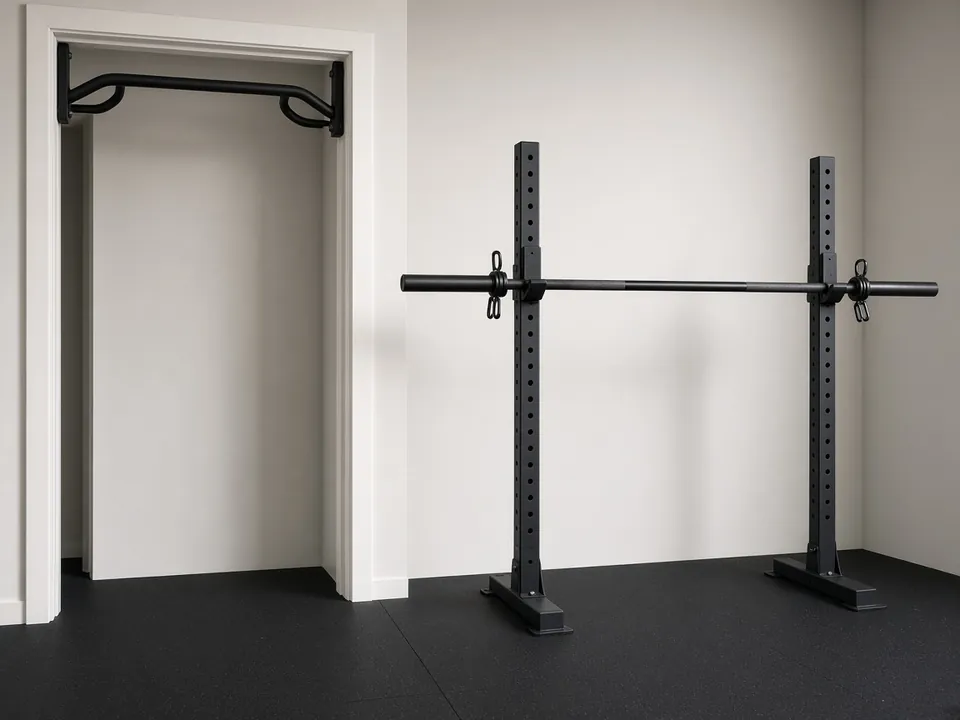
A pull-up bar is a horizontal bar mounted on a wall, doorway or ceiling. It's used for bodyweight exercises like pull-ups and hanging. An overhead press rack is a freestanding structure used for overhead lifts.
Each has different space needs. Let's look closer.
Calculating ceiling needs
You have a 7-foot (84-inch) ceiling and want either a pull-up bar or an overhead press rack.
Pull-up bar
- The bar itself: there is no equipment height to check; what matters is your body.
- Full pull-ups: roughly your height plus about 2 feet (our planning estimate, not a measured figure), about 8 feet for a 6-foot person.
- Under 84 inches: use the bar for dead hangs.
Overhead press rack
- Listed height: REP lists the PR-1050 at 72 inches.
- Ceiling for the rack: 72 + 12 inches (our planning rule of thumb) = 84 inches (7 feet).
- Standing presses: roughly your height plus about 2 feet, so under a 7-foot ceiling use the rack for seated or below-head moves only.
Overhead planning slips
- Ignoring headroom: Add 12 inches above the tallest part of the equipment (our planning rule of thumb).
- Not checking manufacturer specs: Some pull-up bars or press racks may have different dimensions. Always verify with the maker's manual.
- Assuming all equipment is the same: Overhead press racks vary in height and design. Some are compact, others are tall.
- Forgetting about overhead moves: If you plan to do overhead presses, you'll need more ceiling height than just the equipment's height.
- Not measuring twice: Measure twice; returns on racks are expensive.
Side by side: bar vs press rack
| Feature | Pull-Up Bar | Overhead Press Rack |
|---|---|---|
| Ceiling Height Needed | No equipment height; full pull-ups need roughly your height + about 2 ft | Listed height + 12 in (PR-1050: 72 + 12 = 84 in); standing presses need roughly your height + about 2 ft |
| Installation | Easy to mount on wall or ceiling | Requires floor space and may need wall mounting |
| Overhead Use | No | Yes |
| Weight Capacity | Maker-rated limit (see the spec page) | Maker-rated limit (see the spec page) |
| Suits | Bodyweight training, pull-ups, hanging | Overhead lifts, shoulder presses |
Pick the bar or the rack
- You have a 7-foot ceiling: a bar for dead hangs, or a rack for seated and below-head moves.
- You need overhead press functionality: Overhead press rack.
- You have limited floor space: Pull-up bar.
- You want to do both bodyweight and overhead lifts: Use a pull-up bar with a separate overhead press rack.
- Your ceiling is at least your height plus about 2 feet: either works for full pull-ups or standing presses.
Example: a studio apartment with a 7-foot ceiling
You live in a studio with a 7-foot ceiling and want a home gym in a 4-foot by 4-foot corner.
- Pull-up bar: mount it on the wall in the corner; it takes little floor space. At 84 inches, use it for dead hangs, not full pull-ups. Check the wall can take the load.
- Overhead press rack: a 72-inch rack fits under 84 inches with 12 inches spare, but only for seated or below-head moves, and its footprint plus 18 inches each way must fit the 48 × 48 in corner; check the maker's base size, as most racks won't.
In this case, the bar is the simpler fit for hanging work; pick the rack only if you want seated pressing.
Planning numbers: ceiling height
| Equipment | Listed height | Ceiling to plan for |
|---|---|---|
| REP PR-1050 short power rack | 72 in | 84 in (7 ft) |
| REP Arcadia functional trainer | 80.8 in | 92.8 in |
| REP Arcadia Max | 87.6 in | 99.6 in |
| Force USA G3 all-in-one | 87 in | 99 in |
Sources: REP rack guide for the PR-1050 (72 in) and PR-1000 (83.6 in); REP Arcadia and Arcadia Max product pages; Force USA G3 product page. Makers change specs; check the page before you buy.
Questions about pull-up bars and press racks
Q: Can I use a pull-up bar if I have a 6-foot ceiling?
A: For dead hangs, only if you can hang at full arm's length with your feet clear of the floor (bend your knees if needed). Full pull-ups need roughly your height plus about 2 feet (our planning estimate, not a measured figure).
Q: What's the minimum ceiling height for an overhead press rack?
A: The rack's listed height plus 12 inches (our planning rule of thumb): REP lists the PR-1050 at 72 in, so 84 in. Standing presses need roughly your height plus about 2 feet.
Q: Can I install an overhead press rack on a wall?
A: Yes, but it's more common to install it on the floor. Wall-mounted racks are less common and may require additional support.
Q: What if I have a 7-foot ceiling but want to do overhead presses?
A: Under a 7-foot ceiling, keep the rack for seated or below-head moves, or press standing somewhere with roughly your height plus about 2 feet of ceiling.
Q: How do I check if my ceiling can support the weight of a pull-up bar or press rack?
A: For a ceiling- or wall-mounted bar, follow the maker's mounting instructions and ask your landlord or a structural engineer about the joists or studs. For a freestanding rack, use the floor load calculator to estimate load per square foot.
Related guides
If you're still unsure about your ceiling height, use the ceiling height calculator to get a precise measurement. For more help with small-space equipment, check out home gym equipment that fits small spaces.
If you're looking for layouts that work with low ceilings, see how to choose home gym equipment for low ceiling spaces.
For more on measuring your space, visit how to measure your space for a home gym.
If you're concerned about floor load capacity, read up on floor load capacity for home gym equipment.
And if you're in a garage, check out how to choose home gym equipment for a garage.
This guide is designed to help you make an informed decision based on your space and needs. Always verify with the manufacturer and your landlord or building owner before installation.
Sources and method
- International Residential Code, Table R301.5 (minimum uniformly distributed live loads), as adopted in WAC 51-51-0301: 40 psf for areas other than sleeping areas and 30 psf for sleeping areas (local amendments vary).
- ICC Digital Codes: IRC 2018 Section R301.5: official text of the residential live-load table
- CPSC: Anchor It! furniture and TV tip-over prevention: why tall, heavy items should be anchored to the wall
- Factors and planning values on this page are TinyGymGuide example values (see Sources & method), not measured or maker figures.