Floor mats vs rubber tiles for home gyms
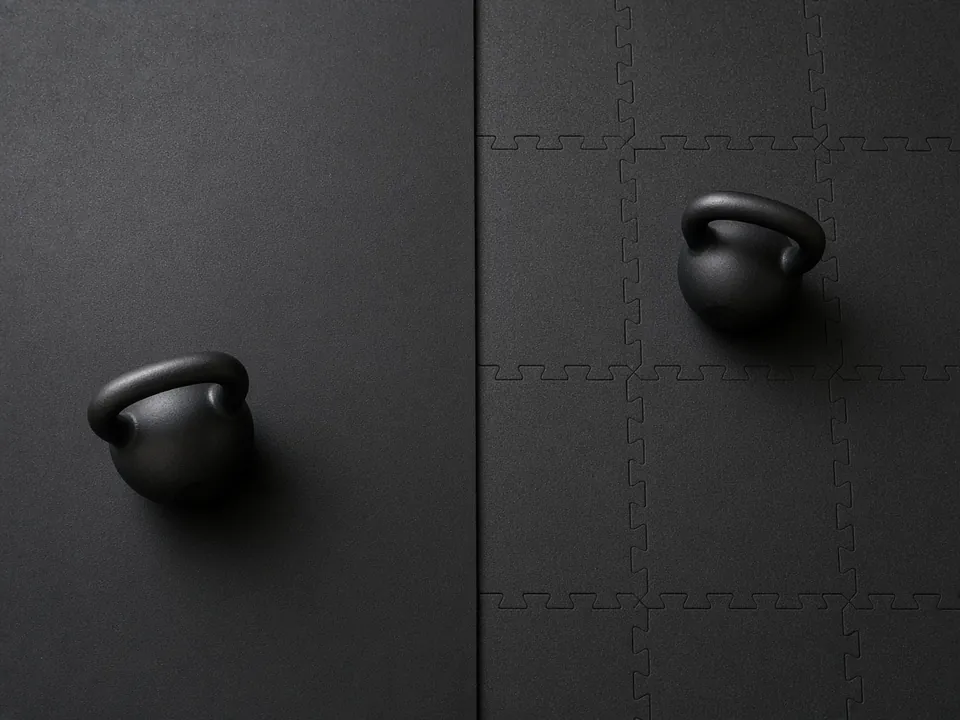
Updated 2026-10-22 · By Charland & Co. · Based on published specs and public sources; we have not tested the products discussed.
Quick answer
Rubber tiles are generally denser than standard foam floor mats, which suits heavy equipment like barbells and weight plates. Foam mats are softer and lighter, which suits bodyweight work and light dumbbells; compare per-square-foot prices. Check thickness and density on the maker's spec page, and put tiles under anything you plan to drop.
What are floor mats and rubber tiles?
Floor mats and rubber tiles are both used to protect your home gym floor from damage caused by heavy weights, sweat, and movement. However, they differ in material, thickness, durability, and how they handle impact and weight distribution.
Floor mats are typically made of foam or rubber and are designed to be placed under equipment or used as a general-purpose covering. They are often thinner and more flexible, which makes them easier to move and cut to size.
Rubber tiles are often thicker than foam mats and are often interlocked or glued together into one surface. Rubber tiles are a common choice under heavy equipment. Check the maker's thickness and use rating before putting heavy equipment on them.
Calculating floor load and protection needs
Let's say you have a 5x5 foot (25 sq ft) home gym space and plan to install a barbell rack that weighs 300 lbs. You also plan to use a 200-lb weight plate set.
Step 1: Calculate Total Weight
Total weight = 300 lbs (barbell rack) + 200 lbs (weight plates) = 500 lbs
Step 2: Calculate Floor Load
Per item: rack + plates 500 lb ÷ rack footprint (e.g. 4 × 4 = 16 sq ft) ≈ 31.3 lb/sq ft. Compare it with what your landlord or a structural engineer confirms. The IRC 40/30 psf figures are design minimums for loads spread evenly across a floor, not a safe rating for a loaded rack.
Step 3: Compare with Floor Material Protection
- Floor mats (foam or thin rubber): may compress or shift under heavy weights.
- Rubber tiles: spread point loads and protect the surface better than thin mats; they do not raise the floor's capacity.
Step 4: Choose Based on Needs
If your floor is concrete and you plan to use heavy equipment, rubber tiles are a common choice. If you're using lighter equipment or have a wooden floor, floor mats may suffice.
Flooring choices that backfire
- Using thin mats for heavy equipment: Thin mats can compress or shift, leading to uneven weight distribution and potential floor damage.
- Ignoring floor type: Concrete and wooden floors have different needs. Rubber tiles are a common choice on concrete, while foam mats are softer underfoot on wood.
- Not measuring your space: Mats and tiles come in standard sizes, but you may need to cut or interlock them to fit your space.
- Overlooking thickness: Check each product's listed thickness on the maker's spec page.
- Neglecting ventilation: Mats can trap moisture, leading to mold or mildew. Check your space is well-ventilated.
Side by side: mats vs tiles
| Feature | Floor Mats | Rubber Tiles |
|---|---|---|
| Thickness | Check the maker's listed thickness | Check the maker's listed thickness |
| Durability | Foam compresses over time | Rubber resists compression better than foam |
| Under heavy equipment | Light equipment | Heavy equipment |
| Installation | Easy to move and cut | May require interlocking or gluing |
| Cost | Depends on product; compare per-square-foot prices | Depends on product; compare per-square-foot prices |
| Comfort | Softer underfoot | Firmer |
When mats or tiles make sense
- You have a small space and light equipment: Floor mats are easier to move and store.
- You use heavy equipment like barbells or weight plates: Rubber tiles are a common choice under heavy equipment because they resist denting and spread point loads better than foam.
- Your floor is concrete: Rubber resists compression better than foam.
- You have a wooden floor and want comfort: Floor mats with foam padding are a good option.
- You need a long-lasting solution: Check the maker's warranty and wear specs.
Example: tiles in a 10x10 room
Imagine you have a 10x10 foot (100 sq ft) space and plan to install a full home gym with a barbell rack, dumbbell rack, and a pull-up bar. You also want to use the space for cardio and stretching.
Step 1: Measure Your Space
Your space is 10x10 ft = 100 sq ft.
Step 2: List Each Weight
- Barbell rack: 300 lbs
- Dumbbell rack: 200 lbs
- Pull-up bar: 50 lbs
Step 3: Calculate Floor Load
Per item: barbell rack 300 lb ÷ rack footprint (e.g. 4 × 4 = 16 sq ft) ≈ 18.8 lb/sq ft; work out the dumbbell rack and the pull-up bar the same way, each on its own footprint. Compare it with what your landlord or a structural engineer confirms.
Step 4: Choose Floor Protection
- Floor mats: May not handle the weight well, especially under the barbell rack.
- Rubber tiles: spread point loads and protect the surface better than thin mats; they do not raise the floor's capacity.
Step 5: Install Rubber Tiles
Cover the entire floor with interlocking rubber tiles. This helps protect the floor surface; it does not raise the floor's capacity.
Step 6: Add Mats for Comfort
Place thin foam mats under the pull-up bar and around the cardio area for added comfort.
Planning numbers: floor load
| Room | Code minimum (IRC R301.5) |
|---|---|
| Most rooms | 40 lb/sq ft |
| Bedrooms | 30 lb/sq ft |
Worked example: 600 lb on a 48 × 48 in (16 sq ft) footprint = 37.5 psf.
Questions about mats and tiles
Q: Are rubber tiles easier to clean than floor mats?
A: It depends on the product; check the maker's care instructions. Many rubber tiles can be wiped down with a damp cloth or mild cleaner.
Q: Can I use floor mats on a concrete floor?
A: Yes, but they may not provide the same level of protection as rubber tiles. Thin mats may compress over time.
Q: Do rubber tiles make a lot of noise when you walk on them?
A: They can still make noise when weights drop or equipment moves; check the maker's specs for thickness and surface.
Q: Can I use floor mats for overhead exercises like pull-ups?
A: Yes, but they may not provide the same level of support as rubber tiles. Check the mats are thick enough to help protect the floor.
Q: How do I know if my floor can handle the weight of my gym equipment?
A: The calculator estimates your load; only your landlord or a structural engineer can tell you the floor's capacity.
Related guides
- How to Measure Your Space for a Home Gym
- How to Calculate Floor Load for Home Gym Equipment
- How to Choose Home Gym Equipment for a Studio Apartment
- How to Choose Home Gym Equipment for a Garage
- How to Calculate Home Gym Equipment Footprint
Sources and method
- International Residential Code, Table R301.5 (minimum uniformly distributed live loads), as adopted in WAC 51-51-0301: 40 psf for areas other than sleeping areas and 30 psf for sleeping areas (local amendments vary).
- ICC Digital Codes: IRC 2018 Section R301.5: official text of the residential live-load table
- CPSC: Anchor It! furniture and TV tip-over prevention: why tall, heavy items should be anchored to the wall
- Factors and planning values on this page are TinyGymGuide example values (see Sources & method), not measured or maker figures.